The Complete Scalping Strategy Workflow
From Macro Trend Alignment to Perfectly Sized 1-Minute Entries. Looking for a structured scalping strategy that removes guesswork and improves consistency?
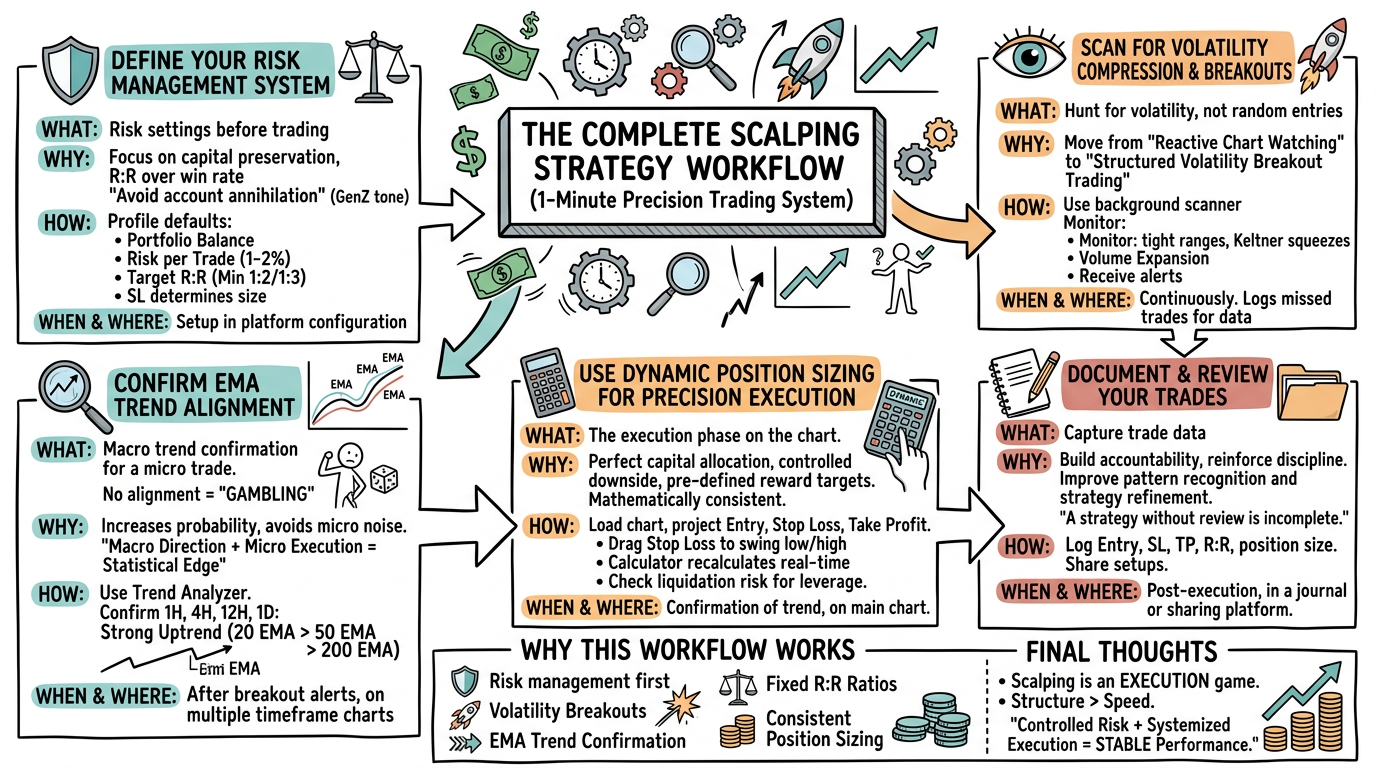
Successful 1-minute scalping isn't about predicting price — it's about executing a repeatable risk management trading system with precision. In fast-moving markets, hesitation kills opportunity. If you're manually calculating position size while price breaks out, you're already too late.
This guide outlines a complete intraday trading workflow — from macro trend alignment to mathematically accurate position sizing — designed for speed, discipline, and long-term profitability.
Step 1: Define Your Risk Management System (The Foundation of Profitable Scalping)
Every profitable scalping strategy starts with strict risk management. Before entering any trade, configure your Profile defaults:
- Portfolio Balance – Total trading capital
- Risk Per Trade (%) – Typically 1–2% of total capital
- Target Risk:Reward Ratio – Minimum 1:2 or 1:3
Why this matters: Professional traders don't focus on win rate — they focus on risk-to-reward ratio and capital preservation.
Once your risk parameters are defined, your position sizing calculator automatically adjusts trade size based on your stop loss distance. This ensures consistent dollar risk per trade, no emotional oversizing, and no account-destroying losses. In scalping, survival is edge.
Step 2: Scan for Volatility Compression and Breakout Opportunities
The best 1-minute scalping strategy doesn't rely on random entries. It hunts volatility. Use a background market scanner to monitor:
- Volatility compression (tight price ranges)
- Keltner Channel squeezes
- Volume expansion breakouts
🔔 Background Notifications
Don't stare at charts all day. Enable Browser Notifications on the scanner page. The platform works in the background and sends you a native OS alert the exact moment a coin breaks out of compression with a massive volume spike. You only look at the chart when there is an actionable setup.
When price breaks out of compression with increased volume, you receive an alert instantly. This transforms your workflow from ❌ Reactive chart watching to ✅ Structured volatility breakout trading.
All alerts should be logged for review. Missed trades become data for pattern recognition — not frustration.
Step 3: Confirm EMA Trend Alignment (Macro Confluence)
Scalping without higher timeframe confirmation is gambling. When a breakout alert triggers, confirm EMA trend alignment across multiple timeframes (1 Hour, 4 Hour, 12 Hour, 1 Day) using the Trend Analyzer.
A Strong Uptrend is defined as:
20 EMA > 50 EMA > 200 EMA
This alignment signals bullish market structure and significantly increases probability for long setups on the 1-minute chart. This is where many scalpers fail. They trade micro noise. Professionals align Macro direction + Micro execution = Statistical edge.
Step 4: Use Dynamic Position Sizing for Precision Execution
Now comes the execution phase of your scalping workflow. Load the chart and project your Entry, Stop Loss, and Take Profit.
Drag your Stop Loss below the recent swing low (or above swing high for shorts). As you adjust your stop, your position sizing tool recalculates in real time, maintaining fixed percentage risk.
This achieves perfect capital allocation, controlled downside, and pre-defined reward targets. If using leverage, always monitor liquidation risk before executing. The result? Every trade becomes mathematically consistent — regardless of volatility.
Step 5: Document and Review Your Trades
Trade documentation is part of every serious intraday trading system. After execution, capture:
- Entry, Stop Loss, Take Profit
- Risk:Reward ratio
- Position size
Sharing setups builds accountability and reinforces discipline. More importantly, reviewing past trades improves pattern recognition and strategy refinement. A scalping strategy without review is incomplete.
Why This Scalping Workflow Works
This system works because it focuses on what actually matters:
- ✔ Risk management before prediction
- ✔ Volatility expansion instead of random entries
- ✔ EMA trend confirmation for directional bias
- ✔ Fixed risk-to-reward ratios
- ✔ Consistent position sizing
Most traders lose not because of bad indicators — but because of inconsistent execution and poor risk control. A structured trading workflow eliminates both.
Final Thoughts: Scalping Is an Execution Game
The difference between amateur and professional scalpers isn't speed. It's structure. A proper 1-minute scalping strategy must include defined risk per trade, volatility breakout triggers, higher timeframe confluence, automatic position sizing, and trade documentation.
When risk is controlled and execution is systemized, performance stabilizes. And in scalping, stability compounds.
Execute with Precision
Start implementing this system today. Set your risk limits and catch the next breakout.
Launch Breakout Scanner